Google prevent any true freedom of speech or expression... We have to ask why this is?
..... more to follow...

"There are many different paths that lead to the ultimate truth" .... Twitter: @pst007x .... IG: @pst007x
Sunday, 19 April 2015


Monday, 17 February 2014
Spiritual enlightenment
Spiritual enlightenment can only be achieved by a few, who will see the illusion of this reality, ceases to chase material wealth, learn new understanding, learn true love towards all beings, relinquishing greed and hate.
This is achievable but not by those who do not know how to let go and grow. We must forever evolve, and allow ourself to see the total picture, and realising that everyone has an element of truth, and it is through the unification of all ideas that we see the total truth...
However, most will argue and fight a view point, even to the death, never realising that it all just a single perception of the greater view.
It is like two people standing either side of a wall, one side black the other white, and arguing that only they know the colour of the wall... in real terms they are both right and wrong, however the ultimate truth is that there is no wall.
Thursday, 13 February 2014
The Coso Artifact
The Coso Artifact
Mystery from the Depths of Timeby Pierre Stromberg
Copyright © 2000-2003
[Text Last Updated: May 31, 2000]
[Links Updated: May 8, 2003]
Introduction
Creationists have often been criticized for failing to present original research and evidence that would overthrow our contemporary view of human origins in favor of another. However, this is not an entirely fair accusation. The creation "science" field known as OOPARTS, or "Out Of Place ARTifactS" is a lively area of study with numerous examples. This paper will examine the most popular and least understood specimen, the Coso Artifact.
The Discovery
The story of the Coso Artifact has been embellished over the years, but nearly all accounts of the actual discovery are basically unchanged.
The next day in the gift shop's workroom, Mikesell ruined a nearly new diamond saw blade while cutting what he thought was a geode. Inside the nodule that was cut, Mikesell did not find a cavity as so many geodes have, but a perfectly circular section of very hard, white material that appeared to be porcelain. In the center of the porcelain cylinder, was a 2-millimeter shaft of bright metal. The metal shaft responded to a magnet.
There were still other odd qualities about the specimen. The outer layer of the specimen was encrusted with fossil shells and their fragments. In addition to shells, the discoverers noticed two nonmagnetic metallic metal objects in the crust, resembling a nail and a washer. Stranger still, the inner layer was hexagonal and seemed to form a casing around the hard porcelain cylinder. Within the inner layer, a layer of decomposing copper surrounded the porcelain cylinder.
The Initial Investigations
Very little is known about the initial physical inspections of the artifact. According to discoverer Virginia Maxey, a geologist she spoke with who examined the fossil shells encrusting the specimen said the nodule had taken at least 500,000 years to attain its present form. However, the identity of the first geologist is still a mystery, and his findings were never officially published.
Another investigation was conducted by creationist Ron Calais. Calais is the only other individual known to have physically inspected the artifact, and was allowed to take photographs of the nodule in both X ray and natural light. Calais's X-rays brought interest in the artifact to a new level. The X-ray of the upper end of the object seemed to reveal some sort of tiny spring or helix. INFO Journal Publisher Ronald J. Willis speculated that it could actually be "the remains of a corroded piece of metal with threads." The other half of the artifact revealed a sheath of metal, presumably copper, covering the porcelain cylinder.
The Artifact: Where Is It Now?
The last known individual to possess the Coso Artifact was one of the original discoverers, Wallace Lane. According to the Spring 1969 issue of INFO Journal, Lane was the last known person to possess the object. It was on display in his home, but he adamantly refused to allow anyone to examine it. However, he had a standing offer to sell it for $25,000. In September 1999, a national search was attempted to locate any of the original discoverers, but the attempt was fruitless. The authors of this article suspect that Wallace Lane is dead, and the location of the artifact is unknown, possibly destroyed. Virginia Maxey is alive, but is avoiding any public comment. The whereabouts of Mike Mikesell are still unknown.
The Creationists and the Artifact
With such outrageous speculation, individuals familiar with the creation/evolution controversy would assume that fundamentalist Christians would stay far away from such artifacts and stories. But this is far from the case. Numerous creationists have been involved with this artifact since its discovery.
As noted earlier, Ron Calais was involved with the Coso Artifact since its initial discovery. Calais was the individual responsible for the natural light and X-ray photographs of the artifact. He also brought the Coso Artifact to the attention of the Charles Fort Society, publisher of INFO Journal, whose 1969 article is the primary source for information on this object to date. Calais is still a contributor to creationism and most recently had a paper published in the June 1996 edition of the Creation Research Society Quarterly ("Slippery Phylogenies: Evolutionary Speculations on the Origin of Frogs", by Ron Calais and A.W. Mehlert, pp. 44-48.).
Creation Outreach, a Spokane, Washington based creationism ministry promotes the artifact on their website (source:http://home.att.net/~creationoutreach/pages/strange.htm September 22, 1999) by reprinting an article by J.R. Jochmans. Jochman's article on the Creation Outreach's website, originally available through the national Bible-Science Association concluded, "As a whole, the 'Coso artifact' is now believed to be something more than a piece of machinery: The carefully shaped ceramic, metallic shaft and copper components hint at some form of electrical instrument. The closest modern apparatus that researchers have been able to equate it with is a spark plug. However, there are certain features - particularly the spring or helix terminal - that does [sic] not correspond to any known spark plug today." Creation Outreach member Jim Marisch is known to have lectured in local Spokane public school classrooms , but it is unknown if he specifically mentioned the artifact in question. Nevertheless, students exposed to Creation Outreach would inevitably be redirected to their website for further information.
It should also be noted that according to a letter printed in "Atlantis Arising", J.R. Jochmans claims to have ghost-written three quarters of the book "Secrets of the Lost Races" by Rene Noorbergen. "Secrets of the Lost Races" has often been cited as a reference for the Coso Artifact by young-earth creationists.
Carl Baugh, a young-earth creationist whose claim to fame is the promotion of the Paluxy River Tracks, notes the Coso Artifact in his online dissertation (source: http://home.texoma.net/~linesden/cem/diss/diss2.htm October 10, 1999) using material from Noorbergen's "Secrets of the Lost Races."
Elsewhere in the Pacific Northwest, the Institute for Creation Research has been heavily promoting the Coso Artifact through its adjunct faculty member, Dr. Donald Chittick. According to his own literature, Chittick, a Newberg, Oregon resident, holds a Ph.D. in physical chemistry and has taught at the University of Puget Sound and George Fox College. Dr. Chittick is also an active lecturer, having traveled in the United State and Canada for the past 20 years, speaking before students both public and private about creationism. In 1981, he was one of five "creation scientists" who testified in pretrial depositions for the Arkansas "Balanced Treatment Act", which required that "creation science" be taught along with evolutionary biology in that state's public schools. And in 1993, his lecture to public high school students in Stanwood, Washington led to a community furor, threats from the ACLU, and a subsequent shakeup in the local school board.
Though he claims to have little to do with the ICR, Dr. Chittick encourages audiences at his lectures to join the ICR, sells their literature, and signs up interested parties for the ICR's mailing list. Most recently, Donald Chittick delivered his "Puzzle of Ancient Man" lecture on March 9, 1999, in Winnipeg, Manitoba. The event was sponsored by the ICR as part of their "Case for Creation" lecture series. According to the ICR, adjunct faculty members are "expected to be of high moral character and personal integrity, firmly committed to the ICR Tenets and Educational Philosophy."
"The Puzzle of Ancient Man" lecture is basically a summary of Chittick's book of the same title. Like the book, Chittick begins his lecture by presenting the Coso Artifact as evidence that ancient civilizations were extremely advanced. Presuming that it is an ancient spark plug, Chittick explains, "A spark plug is evidence of fairly sophisticated development. Reliable dates for such finds are difficult to obtain. However, it has been commonly assumed that formation of geodes requires significant amounts of time. Finding a spark plug in a rock considered to be very old would indeed give it the label of an out-of-place artifact. Evidence of advanced technology, like spark plugs, should not, according to evolutionism, be discovered in old rocks."
Problems with the Artifact Story
"There's no question about it, " Windham replied, barely containing his laughter, "it's a spark plug."
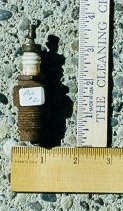
Stromberg asked Windham if he could identify the particular make of the spark plug. Windham replied he was certain that it was a 1920's era Champion spark plug. Stromberg was stunned by the collector's certainty, but Windham insisted that he had nailed the identification. Windham offered to send two identical spark plugs, the only possible but slight difference being the diameter of the packing nut at the base of the plug. Stromberg accepted Windham's offer and a few days later a package arrived in the mail.
Ten days after the phone call with Windham, Pierre Stromberg received a phone call from Bill Bond, founder of the Spark Plug Collectors of America, and curator of a private museum of spark plugs containing more than two thousand specimens. Bond said he hadn't spoken to Windham, but said he thought he knew the identity of the Coso Artifact, "A 1920s Champion spark plug." Spark plug collector Mike Healy also concurred with Bond and Windham's assessment about the spark plug. The fourth collector, Jeff Bartheld, Vice-President of the Spark Plug Collectors of America contacted Stromberg via postal mail on October 18, 1999, and also confirmed that the artifact was a 1920s Champion spark plug. To date, there has been no dissent in the spark plug collector community as to the origins of the Coso Artifact.
Since Chad Windham mentioned that spark plug collectors enjoy pulling pranks on one another, the question of deliberate fraud inevitably crops up in relation to the Coso Artifact. However, there is little hard evidence that the original discoverers intended to deceive anyone from the start. Pacific Northwest Skeptics investigated the Spark Plug Collectors of America. The group formed in 1975, well after the discovery of the artifact, and none of the three discoverers was ever affiliated in any way that the collectors can recall. Windham and Bond insist that while spark plug collectors enjoy hoaxing one another, they cannot imagine that any of their members would take a prank this far.
Comparisons and Analysis
On September 14, 1999, Stromberg received a package from Chad Windham. Inside the package were the two spark plugs Windham had promised along with an analysis of the specimens. Windham writes:
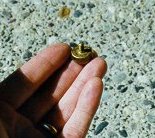
Windham's letter did indeed match a careful analysis of the specimens. Most striking is the brass "top hat" that has so vexed previous attempts to provide a rational explanation for the artifact. But the similarities are more than skin deep. Because Windham had chipped the brass top hat off specimen #1, the spark plug revealed a metal shaft terminating in a flared end, presumably to help secure the top hat to the plug's porcelain cylinder. This revelation led to speculation that such a flared tip could also be visible in the original X-ray of the brass hat. And indeed, as shown at left, the flared end of the metal shaft also appears in the Coso Artifact. The shaft in the X-ray, just below the flare, also reveals deterioration until it meets the porcelain cylinder. This, too, is exactly what we would expect if the artifact is a 1920s-era Champion spark plug. An X ray of the authors' own disassembled specimen reveals a picture very similar to the original X-ray of the Coso Artifact. As with the original artifact, the central metal shaft of both specimens responds to a magnet.
Proponents of fantastic stories regarding the artifact have made mention of mysterious copper rings that encase the porcelain. But this too can be easily explained. Specimen #1 provided by Chad Windham was completely disassembled, revealing a pair of copper rings sandwiching an asbestos lining (right). According to Windham, this design was necessary because porcelain and steel have vastly differing expansion rates, so the copper was used for compensation purposes.
Specimen #2 was not disassembled by Windham, but also presented a feature that could explain why the artifact had not been identified decades ago. Specimen #2, though suffering from severe tarnish, came with a top nut screwed into its top hat. Almost all Champion spark plug advertisements of the first half of the twentieth century showed pictures of their spark plugs including the top nut already screwed into place. In some cases, the top nut comes in two forms, one of which closely mimics the tip of today's contemporary spark plugs, which have no threading whatsoever. So it becomes rather easy to understand why the appearance of threads in the Coso Artifact seemed so puzzling to the original investigators.
Spark plug collectors are quite familiar with spark plugs that have been found in unusual places. The Summer 1998 issue of "The Igniter," published by the Spark Plug Collectors of America, features such an item on page 20. Collector Joe Cook recounted, "Once while scuba diving, a friend of mine made a rare discovery with his underwater metal detector. It looks like a ball of barnacles and shells, but has a spark plug top sticking out of it.
Apparently this plug has been under water for quite some time! He asked me if I still collected plugs. I said yes and then he asked me if I ever heard of a 'King Neptune' special. I said no and headed for the 'Master list' to look it up. When I couldn't find a 'King Neptune' special he began to laugh and handed me the barnacle covered plug and he said 'bet you don't have one like this.' He was right!"
It should be noted that the corrosion of the Coso Artifact almost completely destroyed any of the iron-alloy-based components, with the exception of the metal shaft encased in the porcelain cylinder. The samples received from Chad Windham also revealed corrosion of the iron-based components, but the brass top hats were unscathed, with the exception of some tarnishing. If the Coso Artifact is indeed a 1920s-era Champion spark plug, the X-ray of an almost perfectly preserved top hat is exactly what one would expect. Brass, a copper-zinc alloy is commonly engineered to resist corrosion far better than iron-based alloys. In harsh environments, copper tends to outlast iron, but still succumbs fairly quickly. The rates of decay in the Coso Artifact match the rates of decay one would see in a 1920's era Champion spark plug. For an excellent review of how ferrous and non-ferrous alloys decay over time, please see "The Elements of Archaeological Conservation" by J.M. Cronyn. This article includes numerous photographs, including X-rays, of contemporary objects that have completely decayed into oxide nodules. Like the Coso Artifact, these examples also feature empty cavities where the original materials once resided. Examples include X-rays of a nodule containing the perfectly preserved shape of a bolt, plating on a padlock (including its internal workings), and a belt buckle.
The formation of the iron oxide nodule likely was hastened by the fact that corrosive "mineral dust" is blown off of the dry lake bed of Lake Owen and onto the surrounding uplands where the artifact was discovered. Salts created by the evaporation of the lake water is regularly blown off of the lake bed by local windstorms. The U.S. Geological Survey has conducted extensive investigations of this phenomena (Source http://geochange.er.usgs.gov/sw/impacts/geology/owens/May 31, 2000).
Finally, as noted earlier, the last known individual in possession of the artifact was Wallace Lane, who was offering it for sale for $25,000. Bill Bond, a spark plug museum curator was asked how much a 1920s-era Champion spark plug would be worth today. His answer was, "A couple o' bucks. Max."
Reaction from the Paranormal Community
During the course of research, the authors of this paper asked Dr. Chittick why he felt the Coso Artifact was an object worthy of presentation to the public. Dr. Chittick was specifically asked how he reconciled a previous age estimate of 500,000 years with his young-earth creationist beliefs. On September 29, 1999 Chittick responded:
three discoverers had separately searched for geodes all morning before consolidating their collections in a single sack. Even if the exact location was discovered, the artifact was an oxide nodule freely laying on the surface, so the strata where the item was discovered is irrelevant.
Once the investigation revealed beyond a reasonable doubt the true origins of the artifact, Dr. Chittick was informed by Pierre Stromberg via postal mail. Dr. Chittick was warned about the publication of this paper, and was urged to issue a preemptive retraction as well as paste a disclaimer in his book detailing the Coso Artifact story as fallacious. Dr. Chittick never responded and may be still promoting a 1920s-era Champion spark plug as evidence of advanced technology of the ancient past.
Ken Clark of Spokane's Creation Outreach at first expressed interest in the new discoveries. But when he learned that the true identity was a 1920s-era Champion spark plug and was offered detailed proof, he no longer communicated with the authors of this article. As of May 7, 2000, Creation Outreach continues to promote the spark plug on their website as evidence of a technologically advanced ancient civilization.
Conclusion
The Coso Artifact is a remarkable example of how creation "science" fails when the assumptions of its theory are implemented in a real life archaeological situation. Young-earth creationists commonly assume that almost all sedimentary layers were deposited during the Great Flood. Therefore, any items closely associated with such strata must date back to the time of Noah.
Perhaps the most surprising revelation is the stunningly poor research Dr. Chittick conducted regarding the artifact. Several times he referenced creationist articles that should have cast the original claims in extreme doubt. But somehow, he continued to be fascinated by the artifact. Anti-creationists familiar with Dr. Chittick will remember a previous incident with Dr. Chittick. When confronted about his fallacious statements by Jim Lippard regarding Lucy's knee joint in the mid 1990s, he ignored these warnings and continued to mislead his audiences until confronted in person by Pierre Stromberg at the conclusion of a lecture in Seattle. It is possible that Dr. Chittick could be still promoting the Coso Artifact both in lectures and in his book without acknowledging any of his private conversations with the authors of this article.
The Coso Artifact was indeed a remarkable device. It was a 1920s-era Champion spark plug that likely powered a Ford Model T or Model A engine, modified to possibly serve mining operations in the Coso mountain range of California. To suggest that it was a device belonging to an advanced ancient civilization of the past could be interpreted as true, but is an exaggeration of several thousand years.
Acknowledgments
This paper would not have been possible without the gracious help from the following individuals:Chad Windham, Bill Bond, Mike Healy, Jeff Bartheld, Arnie Voigt, Dr. David Q. King, Ken Atkins, Gary L. Bennett, Dr. Alan Bowes, Linda Safarli, Casey Doyle, Paul Cook, and Ross Langerak.References
Willis, Ronald J. 1969 (Spring). The Coso Artifact. The INFO Journal 1(4): 4-13.
Cook, Joe. 1998 (Summer). Where Did You Get That? The Igniter 23(3): 20.
Steiger, Brad. 1974. Mysteries of Time and Space. Prentice-Hall, New Jersey.
Anonymous. 1998 (March-May). Bell-ieve It: Rapid rock formation rings true. Creation 20(2): 6.
Anonymous. 1991 (December-February). Fossil pliers show rock doesn't need millions of years to form! Creation 14(1): 20
Anonymous. 1998 (June-August). Fascinating Fossil Fence-Wire. Creation 20(3)
Noorbergen, Rene. 1977. Secrets of the Lost Races. Bobs-Merrill Company.
Steiger, Brad. 1979 (March 4). Were Ancient Scientists Really Tuned to Today? Parade. 9-10
Cronyn, J. M. 1990. The Elements of Archaeological Conservation. Routledge, London.
Anonymous. 1999 (September-November). Sparking interest in rapid rocks. A 'spark-plug fossil' has lessons for long-agers. Creation 21(4). 6.
Chittick, Donald E. 1997. The Puzzle of Ancient Man. Precision Graphics, Oregon.
Original Source: http://www.talkorigins.org/faqs/coso.html
Mystery from the Depths of Timeby Pierre Stromberg
Copyright © 2000-2003
[Text Last Updated: May 31, 2000]
[Links Updated: May 8, 2003]
Introduction
Creationists have often been criticized for failing to present original research and evidence that would overthrow our contemporary view of human origins in favor of another. However, this is not an entirely fair accusation. The creation "science" field known as OOPARTS, or "Out Of Place ARTifactS" is a lively area of study with numerous examples. This paper will examine the most popular and least understood specimen, the Coso Artifact.
The Discovery
The story of the Coso Artifact has been embellished over the years, but nearly all accounts of the actual discovery are basically unchanged.
 |
On February 13, 1961, Wallace Lane, Virginia Maxey, and Mike Mikesell were seeking interesting mineral specimens, particularly geodes, for their "LM & V Rockhounds Gem and Gift Shop" in Olancha, California. On this particular day, the trio were about six miles northeast of Olancha, near the top of a peak about 4,300 feet in elevation and about 340 feet above the dry bed of Owens Lake. According to Maxey, "We hiked about three miles north, after we had parked some five miles east of State Highway 395, south of Olancha, California." At lunchtime, after collecting rocks most of the morning, all three placed their specimens in the rock sack Mikesell was carrying.
The next day in the gift shop's workroom, Mikesell ruined a nearly new diamond saw blade while cutting what he thought was a geode. Inside the nodule that was cut, Mikesell did not find a cavity as so many geodes have, but a perfectly circular section of very hard, white material that appeared to be porcelain. In the center of the porcelain cylinder, was a 2-millimeter shaft of bright metal. The metal shaft responded to a magnet.
There were still other odd qualities about the specimen. The outer layer of the specimen was encrusted with fossil shells and their fragments. In addition to shells, the discoverers noticed two nonmagnetic metallic metal objects in the crust, resembling a nail and a washer. Stranger still, the inner layer was hexagonal and seemed to form a casing around the hard porcelain cylinder. Within the inner layer, a layer of decomposing copper surrounded the porcelain cylinder.
The Initial Investigations
 |
Very little is known about the initial physical inspections of the artifact. According to discoverer Virginia Maxey, a geologist she spoke with who examined the fossil shells encrusting the specimen said the nodule had taken at least 500,000 years to attain its present form. However, the identity of the first geologist is still a mystery, and his findings were never officially published.
Another investigation was conducted by creationist Ron Calais. Calais is the only other individual known to have physically inspected the artifact, and was allowed to take photographs of the nodule in both X ray and natural light. Calais's X-rays brought interest in the artifact to a new level. The X-ray of the upper end of the object seemed to reveal some sort of tiny spring or helix. INFO Journal Publisher Ronald J. Willis speculated that it could actually be "the remains of a corroded piece of metal with threads." The other half of the artifact revealed a sheath of metal, presumably copper, covering the porcelain cylinder.
The Artifact: Where Is It Now?
The last known individual to possess the Coso Artifact was one of the original discoverers, Wallace Lane. According to the Spring 1969 issue of INFO Journal, Lane was the last known person to possess the object. It was on display in his home, but he adamantly refused to allow anyone to examine it. However, he had a standing offer to sell it for $25,000. In September 1999, a national search was attempted to locate any of the original discoverers, but the attempt was fruitless. The authors of this article suspect that Wallace Lane is dead, and the location of the artifact is unknown, possibly destroyed. Virginia Maxey is alive, but is avoiding any public comment. The whereabouts of Mike Mikesell are still unknown.
Fantastic Speculations
Ever since the artifact was first discovered, numerous individuals have speculated about its mysterious origin and possible use.
Virginia Maxey speculated that "one possibility is that it is barely 100 years old - something that lay in a mud bed, then got baked and hardened by the sun in a matter of a few years." However it was Maxey who supplied the claim that the artifact could be at least 500,000 years old. "Or else it is an instrument as old as legendary Mu or Atlantis. Perhaps it is a communications device or some sort of directional finder or some instrument made to utilize power principles we know nothing about."
INFO Journal editor Paul J. Willis speculated that the artifact was some sort of spark plug. His brother found the suggestion extraordinary. "I was thunderstruck," he wrote, "for suddenly all the parts seemed to fit. The object sliced in two shows a hexagonal part, a porcelain or ceramic insulator with a central metallic shaft - the basic components of any spark plug." However, the two could not reconcile the upper end featuring a "spring", "helix", or "metal threads" with any contemporary spark plug. So the mystery continued. The artifact even appeared briefly at the end of an "In Search Of..." episode hosted by Leonard Nimoy.
The Internet offers a plethora of other opinions on the subject. While most websites simply report the mystery as described earlier, some have taken to speculate on the purpose and origin of such a device. Brian Wood, described as "International Director of MICAP (Multinational Investigations Cooperative on Aerial Phenomena) and Producer/Director of The Paranet Continuum Radio Program" suggested that if it isn't simply a spark plug, "My guess would be some sort of antenna. The construction reminds me of modern attempts at superconductors. Wonder if anyone's tried replicating the thing using ceramic superconductors and then cooling the thing off with liquid nitrogen to see what happens." (Source :http://www.mm2000.nu/sphinxt.html September 10, 1999).
Joe Held's "Joe's UFOs and Space Mysteries" thinks the device "looks similar to a small capacitor with several different materials. The object is roughly the size of an auto spark plug. Since the formation of geodes can take millions of years this was a very curious find indeed." (Source: http://members.tripod.com/J_Kidd/index.html September 10, 1999).
The Creationists and the Artifact
With such outrageous speculation, individuals familiar with the creation/evolution controversy would assume that fundamentalist Christians would stay far away from such artifacts and stories. But this is far from the case. Numerous creationists have been involved with this artifact since its discovery.
As noted earlier, Ron Calais was involved with the Coso Artifact since its initial discovery. Calais was the individual responsible for the natural light and X-ray photographs of the artifact. He also brought the Coso Artifact to the attention of the Charles Fort Society, publisher of INFO Journal, whose 1969 article is the primary source for information on this object to date. Calais is still a contributor to creationism and most recently had a paper published in the June 1996 edition of the Creation Research Society Quarterly ("Slippery Phylogenies: Evolutionary Speculations on the Origin of Frogs", by Ron Calais and A.W. Mehlert, pp. 44-48.).
Creation Outreach, a Spokane, Washington based creationism ministry promotes the artifact on their website (source:http://home.att.net/~creationoutreach/pages/strange.htm September 22, 1999) by reprinting an article by J.R. Jochmans. Jochman's article on the Creation Outreach's website, originally available through the national Bible-Science Association concluded, "As a whole, the 'Coso artifact' is now believed to be something more than a piece of machinery: The carefully shaped ceramic, metallic shaft and copper components hint at some form of electrical instrument. The closest modern apparatus that researchers have been able to equate it with is a spark plug. However, there are certain features - particularly the spring or helix terminal - that does [sic] not correspond to any known spark plug today." Creation Outreach member Jim Marisch is known to have lectured in local Spokane public school classrooms , but it is unknown if he specifically mentioned the artifact in question. Nevertheless, students exposed to Creation Outreach would inevitably be redirected to their website for further information.
It should also be noted that according to a letter printed in "Atlantis Arising", J.R. Jochmans claims to have ghost-written three quarters of the book "Secrets of the Lost Races" by Rene Noorbergen. "Secrets of the Lost Races" has often been cited as a reference for the Coso Artifact by young-earth creationists.
Carl Baugh, a young-earth creationist whose claim to fame is the promotion of the Paluxy River Tracks, notes the Coso Artifact in his online dissertation (source: http://home.texoma.net/~linesden/cem/diss/diss2.htm October 10, 1999) using material from Noorbergen's "Secrets of the Lost Races."
Elsewhere in the Pacific Northwest, the Institute for Creation Research has been heavily promoting the Coso Artifact through its adjunct faculty member, Dr. Donald Chittick. According to his own literature, Chittick, a Newberg, Oregon resident, holds a Ph.D. in physical chemistry and has taught at the University of Puget Sound and George Fox College. Dr. Chittick is also an active lecturer, having traveled in the United State and Canada for the past 20 years, speaking before students both public and private about creationism. In 1981, he was one of five "creation scientists" who testified in pretrial depositions for the Arkansas "Balanced Treatment Act", which required that "creation science" be taught along with evolutionary biology in that state's public schools. And in 1993, his lecture to public high school students in Stanwood, Washington led to a community furor, threats from the ACLU, and a subsequent shakeup in the local school board.
Though he claims to have little to do with the ICR, Dr. Chittick encourages audiences at his lectures to join the ICR, sells their literature, and signs up interested parties for the ICR's mailing list. Most recently, Donald Chittick delivered his "Puzzle of Ancient Man" lecture on March 9, 1999, in Winnipeg, Manitoba. The event was sponsored by the ICR as part of their "Case for Creation" lecture series. According to the ICR, adjunct faculty members are "expected to be of high moral character and personal integrity, firmly committed to the ICR Tenets and Educational Philosophy."
"The Puzzle of Ancient Man" lecture is basically a summary of Chittick's book of the same title. Like the book, Chittick begins his lecture by presenting the Coso Artifact as evidence that ancient civilizations were extremely advanced. Presuming that it is an ancient spark plug, Chittick explains, "A spark plug is evidence of fairly sophisticated development. Reliable dates for such finds are difficult to obtain. However, it has been commonly assumed that formation of geodes requires significant amounts of time. Finding a spark plug in a rock considered to be very old would indeed give it the label of an out-of-place artifact. Evidence of advanced technology, like spark plugs, should not, according to evolutionism, be discovered in old rocks."
Problems with the Artifact Story
Creationist and other proponents of the artifact have woven a riveting story. But a multitude of problems regarding the claims and recent discoveries have cast a much different picture.
The Geologic Evidence: Is the Coso Artifact Encased in a Geode?
The Geologic Evidence: Is the Coso Artifact Encased in a Geode?
 |
When it comes to the geologic evidence, the most stunning claim is that the artifact was discovered in a geode. As Donald Chittick has noted, formation of a geode requires significant amounts of time. But what is often overlooked is that the Coso Artifact possesses no characteristics that would classify it as a geode. It is true that the original discoverers were looking for geodes on the day the artifact was found. But this alone is insufficient evidence that the artifact is a geode.
Geodes consists of a thin outer shell, composed of dense chalcedonic silica, and are filled with a layer of quartz crystals. The Coso Artifact does not possess either feature. Discoverer Virginia Maxey referred to the material covering the artifact as "hardened clay" and noted that it had picked up a miscellaneous collection of pebbles, including a "nail and washer." Analysis of the surface material is noted as having a hardness of Mohs 3, which is not very hard and certainly much softer than chalcedony.
Other arguments regarding the ancient source of the Coso Artifact focus on the alleged fossil shells encrusted on the surface. As noted earlier, if a nail and washer were also found on the surface, the significance of the fossil shells is seriously diminished. Even creationist literature notes how surface materials can lead to mistaken assumptions about the true age of individual objects. Creation Ex Nihilo's June-August 1998 issue features fence wire that had become encased by surface materials including "fossil" seashells (quotes in the original article).
As noted earlier, numerous individuals have speculated about the apparent purpose of the Coso Artifact. The most popular suggestion is that it is some sort of spark plug, designed and manufactured by an advanced civilization eons ago for technological devices equal to or surpassing our own. But as mentioned earlier, there's no reason to assume that the artifact was manufactured thousands of years ago. Some have half-heartedly suggested that the device could have been a contemporary spark plug circa 1961. But ancient artifact proponents point to the X-ray of the top half, which indicates some type of tiny spring or helix mechanism. The content of this X-ray, they argue, runs contrary to what we know about contemporary spark plugs.
A clue to what is revealed in the X-ray lies in one of the earliest articles about the artifact. In the Spring 1969 issue of INFO Journal, Ronald Willis suggested that the upper end of the object "is actually the remains of a corroded piece of metal with threads." The Willis brothers seriously suspected the object was a contemporary spark plug, but were still unable to explain what was in the X-ray. Spark plugs of the 1960's era typically terminated with no visible threading and tapered to a dull point.
Though many of the interested parties agreed that the artifact bore a striking resemblance to a twentieth-century spark plug, no one seems to have considered the idea of evolution - specifically, spark plug evolution.
In the course of investigating the origins of the Coso Artifact, it was determined that mining operations were conducted in the area of discovery early in the twentieth century. This discovery lead to the tantalizing possibility that primitive combustion engines were used for various purposes in the Coso mountain range. Combustion engines were a very new technology at this time, and so we extrapolated that spark plug technology would also have been in its infancy. Even if this assumption were correct, identification of the spark plug in question would seem to be a daunting task. To help the authors of this article identify the Coso Artifact, they decided to turn to a little-known group of experts - The Spark Plug Collectors of America.
Letters were sent to four different spark plug collectors describing the Coso Artifact, including Ron Calais' X-rays of the object in question. Collectors were asked if they could identify what they saw in the photos. The collectors were expected to provide some vague hints, or to not be able to identify the artifact at all. Their actual answers were stunning.
On September 9, 1999, Chad Windham, President of the Spark Plug Collectors of America called Pierre Stromberg of Pacific Northwest Skeptics. Windham initially suspected that Stromberg was a fellow spark plug collector, writing incognito, with the ostensible motive of hoaxing him. His fears were compounded by the fact that there is an actual line of spark plugs named "Stromberg." Windham had also contacted another spark plug collector, strongly suspecting that he was the culprit, and made a point of looking up the website of Pacific Northwest Skeptics to ensure it actually existed.
Though Stromberg repeatedly assured Windham that his intentions were purely for research, he was puzzled why Windham was so suspicious and asked him to explain. Windham replied that it was so obvious to him that the artifact was a contemporary spark plug, the letter had to be a hoax. "I knew what it was the moment I saw the x-rays" Windham stated. He also added that it was not uncommon at all for spark plug collectors to play pranks on one another.
"Are you sure it's a spark plug?" Stromberg asked?
Geodes consists of a thin outer shell, composed of dense chalcedonic silica, and are filled with a layer of quartz crystals. The Coso Artifact does not possess either feature. Discoverer Virginia Maxey referred to the material covering the artifact as "hardened clay" and noted that it had picked up a miscellaneous collection of pebbles, including a "nail and washer." Analysis of the surface material is noted as having a hardness of Mohs 3, which is not very hard and certainly much softer than chalcedony.
Other arguments regarding the ancient source of the Coso Artifact focus on the alleged fossil shells encrusted on the surface. As noted earlier, if a nail and washer were also found on the surface, the significance of the fossil shells is seriously diminished. Even creationist literature notes how surface materials can lead to mistaken assumptions about the true age of individual objects. Creation Ex Nihilo's June-August 1998 issue features fence wire that had become encased by surface materials including "fossil" seashells (quotes in the original article).
The Artifact Itself: What Is It?
A clue to what is revealed in the X-ray lies in one of the earliest articles about the artifact. In the Spring 1969 issue of INFO Journal, Ronald Willis suggested that the upper end of the object "is actually the remains of a corroded piece of metal with threads." The Willis brothers seriously suspected the object was a contemporary spark plug, but were still unable to explain what was in the X-ray. Spark plugs of the 1960's era typically terminated with no visible threading and tapered to a dull point.
Though many of the interested parties agreed that the artifact bore a striking resemblance to a twentieth-century spark plug, no one seems to have considered the idea of evolution - specifically, spark plug evolution.
In the course of investigating the origins of the Coso Artifact, it was determined that mining operations were conducted in the area of discovery early in the twentieth century. This discovery lead to the tantalizing possibility that primitive combustion engines were used for various purposes in the Coso mountain range. Combustion engines were a very new technology at this time, and so we extrapolated that spark plug technology would also have been in its infancy. Even if this assumption were correct, identification of the spark plug in question would seem to be a daunting task. To help the authors of this article identify the Coso Artifact, they decided to turn to a little-known group of experts - The Spark Plug Collectors of America.
Letters were sent to four different spark plug collectors describing the Coso Artifact, including Ron Calais' X-rays of the object in question. Collectors were asked if they could identify what they saw in the photos. The collectors were expected to provide some vague hints, or to not be able to identify the artifact at all. Their actual answers were stunning.
On September 9, 1999, Chad Windham, President of the Spark Plug Collectors of America called Pierre Stromberg of Pacific Northwest Skeptics. Windham initially suspected that Stromberg was a fellow spark plug collector, writing incognito, with the ostensible motive of hoaxing him. His fears were compounded by the fact that there is an actual line of spark plugs named "Stromberg." Windham had also contacted another spark plug collector, strongly suspecting that he was the culprit, and made a point of looking up the website of Pacific Northwest Skeptics to ensure it actually existed.
Though Stromberg repeatedly assured Windham that his intentions were purely for research, he was puzzled why Windham was so suspicious and asked him to explain. Windham replied that it was so obvious to him that the artifact was a contemporary spark plug, the letter had to be a hoax. "I knew what it was the moment I saw the x-rays" Windham stated. He also added that it was not uncommon at all for spark plug collectors to play pranks on one another.
"Are you sure it's a spark plug?" Stromberg asked?
 |
Stromberg asked Windham if he could identify the particular make of the spark plug. Windham replied he was certain that it was a 1920's era Champion spark plug. Stromberg was stunned by the collector's certainty, but Windham insisted that he had nailed the identification. Windham offered to send two identical spark plugs, the only possible but slight difference being the diameter of the packing nut at the base of the plug. Stromberg accepted Windham's offer and a few days later a package arrived in the mail.
Ten days after the phone call with Windham, Pierre Stromberg received a phone call from Bill Bond, founder of the Spark Plug Collectors of America, and curator of a private museum of spark plugs containing more than two thousand specimens. Bond said he hadn't spoken to Windham, but said he thought he knew the identity of the Coso Artifact, "A 1920s Champion spark plug." Spark plug collector Mike Healy also concurred with Bond and Windham's assessment about the spark plug. The fourth collector, Jeff Bartheld, Vice-President of the Spark Plug Collectors of America contacted Stromberg via postal mail on October 18, 1999, and also confirmed that the artifact was a 1920s Champion spark plug. To date, there has been no dissent in the spark plug collector community as to the origins of the Coso Artifact.
Since Chad Windham mentioned that spark plug collectors enjoy pulling pranks on one another, the question of deliberate fraud inevitably crops up in relation to the Coso Artifact. However, there is little hard evidence that the original discoverers intended to deceive anyone from the start. Pacific Northwest Skeptics investigated the Spark Plug Collectors of America. The group formed in 1975, well after the discovery of the artifact, and none of the three discoverers was ever affiliated in any way that the collectors can recall. Windham and Bond insist that while spark plug collectors enjoy hoaxing one another, they cannot imagine that any of their members would take a prank this far.
Comparisons and Analysis
On September 14, 1999, Stromberg received a package from Chad Windham. Inside the package were the two spark plugs Windham had promised along with an analysis of the specimens. Windham writes:
I am enclosing two spark plugs made by Champion Spark Plug company circa - 1920's. Plug #1 is 7/8" - 18 thread. I have loosely assembled the plug, and chipped the "brass hat" off to show the configuration of it and the porcelain under it. Plug #2 is 1/2" NPT - of same design.
The diameter of the porcelain on Plug #1 is slightly less than 3/4" - close to the dimension in your letter. As you can see the base and packing nut which hold the porcelain, are sealed with a copper and asbestos gasket. This corresponds with the article. The center electrode of plugs were made of special alloys which may support "...cut in two in 1961 but five years afterwards had no tarnishing visible."
The sketches included clearly show one rib on the upper end of the porcelain, although Champion used two ribs in this era - probably just an artist's error. The "top hat matches those of "plug 1 and 2."
As for the outer shell, it obviously decayed - probably from salt water (or other corrosive substance) and the outer crust is merely some sort of deposit like sea shells or other deposits collected on the deteriorating surfaces of the spark plug base.
There is NO doubt that this is merely an old spark plug. Most probably, it is a Champion spark plug, similar to the two enclosed.
 |
 |
Proponents of fantastic stories regarding the artifact have made mention of mysterious copper rings that encase the porcelain. But this too can be easily explained. Specimen #1 provided by Chad Windham was completely disassembled, revealing a pair of copper rings sandwiching an asbestos lining (right). According to Windham, this design was necessary because porcelain and steel have vastly differing expansion rates, so the copper was used for compensation purposes.
Specimen #2 was not disassembled by Windham, but also presented a feature that could explain why the artifact had not been identified decades ago. Specimen #2, though suffering from severe tarnish, came with a top nut screwed into its top hat. Almost all Champion spark plug advertisements of the first half of the twentieth century showed pictures of their spark plugs including the top nut already screwed into place. In some cases, the top nut comes in two forms, one of which closely mimics the tip of today's contemporary spark plugs, which have no threading whatsoever. So it becomes rather easy to understand why the appearance of threads in the Coso Artifact seemed so puzzling to the original investigators.
Spark plug collectors are quite familiar with spark plugs that have been found in unusual places. The Summer 1998 issue of "The Igniter," published by the Spark Plug Collectors of America, features such an item on page 20. Collector Joe Cook recounted, "Once while scuba diving, a friend of mine made a rare discovery with his underwater metal detector. It looks like a ball of barnacles and shells, but has a spark plug top sticking out of it.
Apparently this plug has been under water for quite some time! He asked me if I still collected plugs. I said yes and then he asked me if I ever heard of a 'King Neptune' special. I said no and headed for the 'Master list' to look it up. When I couldn't find a 'King Neptune' special he began to laugh and handed me the barnacle covered plug and he said 'bet you don't have one like this.' He was right!"
 |
The formation of the iron oxide nodule likely was hastened by the fact that corrosive "mineral dust" is blown off of the dry lake bed of Lake Owen and onto the surrounding uplands where the artifact was discovered. Salts created by the evaporation of the lake water is regularly blown off of the lake bed by local windstorms. The U.S. Geological Survey has conducted extensive investigations of this phenomena (Source http://geochange.er.usgs.gov/sw/impacts/geology/owens/May 31, 2000).
Finally, as noted earlier, the last known individual in possession of the artifact was Wallace Lane, who was offering it for sale for $25,000. Bill Bond, a spark plug museum curator was asked how much a 1920s-era Champion spark plug would be worth today. His answer was, "A couple o' bucks. Max."
Reaction from the Paranormal Community
During the course of research, the authors of this paper asked Dr. Chittick why he felt the Coso Artifact was an object worthy of presentation to the public. Dr. Chittick was specifically asked how he reconciled a previous age estimate of 500,000 years with his young-earth creationist beliefs. On September 29, 1999 Chittick responded:
The article's speculation that it had taken at least 500,000 years to attain the present form is just that: speculation. Actual petrification of such objects proceeds normally quite rapidly, as is illustrated by several other similar formations. See for instance, the note about the petrified miner's hat on the back cover of Creation Ex Nihilo (Vol. 17, No. 3) for June-August, 1995. See also an article about another "fossil" spark plug in Creation Ex Nihilo (Vol. 21, No. 4) for September-November, 1999 on page 6.
You asked what I thought about its age. My best guess is that it is probably early post-Flood. I have not yet been able to obtain sufficient documentation, so I don't say much publicly. However, there is evidence that they did in fact perhaps have internal combustion engines or even jet engines way back then.
Dr. Chittick's revelation that he was already aware of "fossil" spark plugs was startling. Dr. Chittick was asked in a follow-up letter about how he can positively date the Coso Artifact to the Great Flood since he was already aware of contemporary spark plugs that appear to be fossilized. In his response on October 23, 1999, he commented:
It has not been my privilege to personally examine the Coso artifact or location and strata where it was found. There are two reasons I considered the artifact significant.As noted earlier, the alleged strata where the Coso Artifact was found is unknown since all
1. It obviously is a man-made item.
2. Those who evaluated the strata said that it appeared to be old, not modern strata. Those two items are the principle basis for my conclusion that it was worth study. Certainly it does merit further study in my judgment. Numerous items like that abound, but I haven't been able to document them as thoroughly as I would like, and so I don't say too much about them.
three discoverers had separately searched for geodes all morning before consolidating their collections in a single sack. Even if the exact location was discovered, the artifact was an oxide nodule freely laying on the surface, so the strata where the item was discovered is irrelevant.
Once the investigation revealed beyond a reasonable doubt the true origins of the artifact, Dr. Chittick was informed by Pierre Stromberg via postal mail. Dr. Chittick was warned about the publication of this paper, and was urged to issue a preemptive retraction as well as paste a disclaimer in his book detailing the Coso Artifact story as fallacious. Dr. Chittick never responded and may be still promoting a 1920s-era Champion spark plug as evidence of advanced technology of the ancient past.
Ken Clark of Spokane's Creation Outreach at first expressed interest in the new discoveries. But when he learned that the true identity was a 1920s-era Champion spark plug and was offered detailed proof, he no longer communicated with the authors of this article. As of May 7, 2000, Creation Outreach continues to promote the spark plug on their website as evidence of a technologically advanced ancient civilization.
Conclusion
 |
The Coso Artifact is a remarkable example of how creation "science" fails when the assumptions of its theory are implemented in a real life archaeological situation. Young-earth creationists commonly assume that almost all sedimentary layers were deposited during the Great Flood. Therefore, any items closely associated with such strata must date back to the time of Noah.
Perhaps the most surprising revelation is the stunningly poor research Dr. Chittick conducted regarding the artifact. Several times he referenced creationist articles that should have cast the original claims in extreme doubt. But somehow, he continued to be fascinated by the artifact. Anti-creationists familiar with Dr. Chittick will remember a previous incident with Dr. Chittick. When confronted about his fallacious statements by Jim Lippard regarding Lucy's knee joint in the mid 1990s, he ignored these warnings and continued to mislead his audiences until confronted in person by Pierre Stromberg at the conclusion of a lecture in Seattle. It is possible that Dr. Chittick could be still promoting the Coso Artifact both in lectures and in his book without acknowledging any of his private conversations with the authors of this article.
The Coso Artifact was indeed a remarkable device. It was a 1920s-era Champion spark plug that likely powered a Ford Model T or Model A engine, modified to possibly serve mining operations in the Coso mountain range of California. To suggest that it was a device belonging to an advanced ancient civilization of the past could be interpreted as true, but is an exaggeration of several thousand years.
Acknowledgments
This paper would not have been possible without the gracious help from the following individuals:Chad Windham, Bill Bond, Mike Healy, Jeff Bartheld, Arnie Voigt, Dr. David Q. King, Ken Atkins, Gary L. Bennett, Dr. Alan Bowes, Linda Safarli, Casey Doyle, Paul Cook, and Ross Langerak.References
Willis, Ronald J. 1969 (Spring). The Coso Artifact. The INFO Journal 1(4): 4-13.
Cook, Joe. 1998 (Summer). Where Did You Get That? The Igniter 23(3): 20.
Steiger, Brad. 1974. Mysteries of Time and Space. Prentice-Hall, New Jersey.
Anonymous. 1998 (March-May). Bell-ieve It: Rapid rock formation rings true. Creation 20(2): 6.
Anonymous. 1991 (December-February). Fossil pliers show rock doesn't need millions of years to form! Creation 14(1): 20
Anonymous. 1998 (June-August). Fascinating Fossil Fence-Wire. Creation 20(3)
Noorbergen, Rene. 1977. Secrets of the Lost Races. Bobs-Merrill Company.
Steiger, Brad. 1979 (March 4). Were Ancient Scientists Really Tuned to Today? Parade. 9-10
Cronyn, J. M. 1990. The Elements of Archaeological Conservation. Routledge, London.
Anonymous. 1999 (September-November). Sparking interest in rapid rocks. A 'spark-plug fossil' has lessons for long-agers. Creation 21(4). 6.
Chittick, Donald E. 1997. The Puzzle of Ancient Man. Precision Graphics, Oregon.
Original Source: http://www.talkorigins.org/faqs/coso.html
Monday, 10 February 2014
NASA's Cassini Spacecraft: Views of Saturn's Hexagon
NASA's Cassini Spacecraft Obtains Best Views of Saturn Hexagon
Better views of the hexagon are available now because the sun began to illuminate its interior in late 2012. Cassini captured images of the hexagon over a 10-hour time span with high-resolution cameras, giving scientists a good look at the motion of cloud structures within.

They saw the storm around the pole, as well as small vortices rotating in the opposite direction of the hexagon. Some of the vortices are swept along with the jet stream as if on a racetrack. The largest of these vortices spans about 2,200 miles (3,500 kilometers), or about twice the size of the largest hurricane recorded on Earth.
Scientists analyzed these images in false color, a rendering method that makes it easier to distinguish differences among the types of particles suspended in the atmosphere -- relatively small particles that make up haze -- inside and outside the hexagon.
"Inside the hexagon, there are fewer large haze particles and a concentration of small haze particles, while outside the hexagon, the opposite is true," said Kunio Sayanagi, a Cassini imaging team associate at Hampton University in Virginia. "The hexagonal jet stream is acting like a barrier, which results in something like Earth's Antarctic ozone hole."
The Antarctic ozone hole forms within a region enclosed by a jet stream with similarities to the hexagon. Wintertime conditions enable ozone-destroying chemical processes to occur, and the jet stream prevents a resupply of ozone from the outside. At Saturn, large aerosols cannot cross into the hexagonal jet stream from outside, and large aerosol particles are created when sunlight shines on the atmosphere. Only recently, with the start of Saturn's northern spring in August 2009, did sunlight begin bathing the planet's northern hemisphere.
"As we approach Saturn's summer solstice in 2017, lighting conditions over its north pole will improve, and we are excited to track the changes that occur both inside and outside the hexagon boundary," said Scott Edgington, Cassini deputy project scientist at NASA's Jet Propulsion Laboratory in Pasadena, Calif.
A black-and-white version of the imaging camera movie and movies obtained by Cassini's visual and infrared mapping spectrometer are also tools Cassini scientists can use to look at wind speeds and the mini-storms inside the jet stream.
Cassini launched in 1997 and arrived at Saturn on July 1, 2004. Its mission is scheduled to end in September 2017. The Cassini-Huygens mission is a cooperative project of NASA, the European Space Agency and the Italian Space Agency. JPL manages the mission for NASA's Science Mission Directorate in Washington. JPL designed, developed and assembled the Cassini orbiter and its two onboard cameras. The imaging team is based at the Space Science Institute, Boulder, Colo.
More information about Cassini available at:
http://www.nasa.gov/cassini
http://saturn.jpl.nasa.gov .
Source: LINK
The Black Knight
The story of the black knight UFO begins way back in 1899 with a signal which was picked up by Nikola Tesla, coming from space. This signal was picked up again on various occasions in the 1920's by radio enthusiasts and there were many sightings by astronomers who watched and studied it.
It made newspapers in the 1950's and 1960's. Pictures were taken in the 1960's. In the 1970's the signal was decoded, it was a diagram of Epsilon Bootes star system.
 In 1960 the North American System Listening Station picked up a radar echo. They had detected an unknown satellite in orbit. R.Johnson director of the Adler Planetarium said...
It made newspapers in the 1950's and 1960's. Pictures were taken in the 1960's. In the 1970's the signal was decoded, it was a diagram of Epsilon Bootes star system.
In 1960 the North American System Listening Station picked up a radar echo. They had detected an unknown satellite in orbit. R.Johnson director of the Adler Planetarium said... The object does not even have the decency to maintain a regular schedule like any other heavenly body or man made object we have ever seen. It appears some nights and some nights it does not.
The satellite was in a polar orbit. It was further revealed that this could not have been the work of either Russia or the USA as they could not achieve polar orbit at the time. The USA named the satellite the Black Knight. A special committee was formed to gather information on the mysterious satellite.. An article was put into time magazine about it.
The satellite was photographed on the 3rd September 1960 Long Island and Some seven months after it first appeared on radar image. On 1963 it was seen by an astronaut going into space.
In December 1998 The space craft endeavour was making a journey to the Space Station it recorded several images that many people think to be the Black Knight.
The object is still believed to be in Orbit to this day. NASA explanation to what the object is has changed several times.
Some people believe that it spans back to a previous civilisation from here on earth, or perhaps a watcher from a distant world.
Whatever the case may be it remains a mystery, at least for now.


Source: LINK
Source: LINK
The satellite was photographed on the 3rd September 1960 Long Island and Some seven months after it first appeared on radar image. On 1963 it was seen by an astronaut going into space.
In December 1998 The space craft endeavour was making a journey to the Space Station it recorded several images that many people think to be the Black Knight.
The object is still believed to be in Orbit to this day. NASA explanation to what the object is has changed several times.
Some people believe that it spans back to a previous civilisation from here on earth, or perhaps a watcher from a distant world.
Source: LINK
Source: LINK
Sunday, 9 February 2014
New World Order
Many people have heard of the conspiracy of a 'New World Order', but very few realise the implications.
Loss of freedoms is something that has happened, we have allowed ourselves to live in a society where the Govt can detain you indefinitely, held without trial, all under the power we gave them. The power we gave them when we fell for the 'terrorist' lie, when we gave into fear.
They created the enemies, they created the global mistrust, they created the illusion of division.
This video shows what could happen if their plan succeeds..
This video was made some 50 years ago, yet has a scary relevance in today's world. Perhaps those who made this were trying to educate a young generation into these coming dangers... did they succeed? time will tell..g
Loss of freedoms is something that has happened, we have allowed ourselves to live in a society where the Govt can detain you indefinitely, held without trial, all under the power we gave them. The power we gave them when we fell for the 'terrorist' lie, when we gave into fear.
They created the enemies, they created the global mistrust, they created the illusion of division.
This video shows what could happen if their plan succeeds..
Sunday, 4 November 2012
When you hear a cry for help.... what would you do?
In a time when the world is in chaos, when humanity stands on a knife edge, is all hope lost? When people are in need what would you do to help? Give money or time? Anything?
Would you pull someone from the flames?
 We have to change, start seeing the value in humanity, start to understand the need for love and compassion in this world.
We have created a society where money ranks above people, where there are men, women and children all over the world who go hungry, homeless, unable to afford treatments, etc all because of money, yet billions are given to big corporate organisations, to fund their losses, to feed the 1% at the 'top', whilst people continue to suffer. To put material wealth over a human life is simply wrong!
When will people realise that money is a part of a system that creates division, creates greed and denies basic human rights for many.
Money is just a tool and should not trump basic human needs.
Please Read the following:
Help save a life....
Would you pull someone from the flames?

We have created a society where money ranks above people, where there are men, women and children all over the world who go hungry, homeless, unable to afford treatments, etc all because of money, yet billions are given to big corporate organisations, to fund their losses, to feed the 1% at the 'top', whilst people continue to suffer. To put material wealth over a human life is simply wrong!
When will people realise that money is a part of a system that creates division, creates greed and denies basic human rights for many.
Money is just a tool and should not trump basic human needs.
Please Read the following:
My Journey with Cancer by GVLOANGUY
My beginning was a small black spot in the middle of a discolored area of my forehead. April 2010. First surgery May 2010, second surgery August 2010. I was sent home "clear". They cut me in front of the ear down to below the jaw. One year later when the swelling went down from the 3 hour exploration surgery looking for the Sentinel Node. I could feel small bumps under the skin. I thought it was scar tissue. They were also along the scar line. But it kept growing so I went back to the doctor. My cancer was back. Another surgery. December 22, 2011. (there's a video on this one.) Took out the whole Parotid Gland. I think that's a part of the Lymph system. At that time I was in Stage 3 Recurrant Malignant Melanoma. Well after that surgery, small bumps all along the stitch line. Fouth Surgery took out the bigger ones that bothered me. All the rest were tiny. That was only 10 months ago. Now they're big.
For more info: LINK
Alternative Treatments all the way!
I refused to get Radiation and Chemo. I chose the Alternative treatment options. I still do. Do I regret not getting Radiation and Chemo. NO. I am still pursuing Alternative Therapy. Thus this ChipIn! page. I have found a Cancer Clinic that offers just what I need.
One small problem. MONEY. It's going to cost me $18,000 to get my own PET CT scan (Insurance denied me a PET CT) a Vascular Access PIC Line and Treatment. I know some of you would like to contribute five or ten dollars. So I've set up this page to make that easy. Also hoping you will help spread this page link around your social media sites. fb, twitter etc.
In the end my trust is in the Lord
I believe in God and I believe in the goodness and compassion people. People like you. Thank you in advance for any amount you can afford. Your donations will contribute to my Cancer Treatment and may very well save my life.
Thy will be done. Whatever the outcome. I trust the Lord. Your prayers are always welcome.
Cancer Fund: LinkIf it was possible to save a single life in these dark times, would you?
Help save a life....
 |
| Autumn time |
Thursday, 1 November 2012
Near-death experiences occur when the soul leaves the nervous system and enters the universe, claim two quantum physics experts
World-renowned quantum scientists say they can prove the existence of the soul.
- Ground-breaking theory holds that quantum substances form the soul
- They are part of the fundamental structure of the universe

According to this idea, consciousness is a program for a quantum computer in the brain which can persist in the universe even after death, explaining the perceptions of those who have near-death experiences.
Dr Stuart Hameroff, Professor Emeritus at the Departments of Anaesthesiology and Psychology and the Director of the Centre of Consciousness Studies at the University of Arizona, has advanced the quasi-religious theory.
Life after death: Dr Stuart Hameroff, Professor Emeritus at the University of Arizona, advanced the theory on a television documentary
It is based on a quantum theory of consciousness he and British physicist Sir Roger Penrose have developed which holds that the essence of our soul is contained inside structures called microtubules within brain cells.
They have argued that our experience of consciousness is the result of quantum gravity effects in these microtubules a theory which they dubbed orchestrated objective reduction (Orch-OR).
Thus it is held that our souls are more than the interaction of neurons in the brain. They are in fact constructed from the very fabric of the universe - and may have existed since the beginning of time.
Shocked back to life: The theory holds that when patients have a near death experience their quantum soul is released from the body and re-enters the cosmos, before returning when they are revived
With these beliefs, Dr Hameroff holds that in a near-death experience the microtubules lose their quantum state, but the information within them is not destroyed. Instead it merely leaves the body and returns to the cosmos.
Dr Hameroff told the Science Channel's Through the Wormhole documentary: 'Let's say the heart stops beating, the blood stops flowing, the microtubules lose their quantum state.
'The quantum information within the microtubules is not destroyed, it can't be destroyed, it just distributes and dissipates to the universe at large.
'If the patient is resuscitated, revived, this quantum information can go back into the microtubules and the patient says "I had a near death experience".'
He adds: 'If they're not revived, and the patient dies, it's possible that this quantum information can exist outside the body, perhaps indefinitely, as a soul.'
Evidence: Dr Hameroff believes new findings about the role quantum physics plays in biological processes, such as the navigation of birds, will one day prove his theory
The Orch-OR theory has come in for heavy criticism by more empirically minded thinkers and remains controversial among the scientific community.
MIT physicist Max Tegmark is just one of the many scientists to have challenged it, in a 2000 paper that is widely cited by opponents, the Huffington Post reports.
Nevertheless, Dr Hameroff believes that research in to quantum physics is beginning to validate Orch-Or, with quantum effects recently being shown to support many important biological processes, such as smell, bird navigation and photosynthesis.
Source
Through the Wormhole- Tracking Souls to the Afterlife
Sunday, 19 August 2012
Origins of the Moon
Origins of the Moon
Part I
 |
| The Moon ‘Is the Moon a hollowed-out spaceship sent to orbit our earth in the remote prehistoric past?’ |
Don Wilson, “Our Mysterious Spaceship Moon”
The moon is the most dominant feature in our night sky, inspiring both wonder and myth since antiquity. While the past few decades have offered new understanding about many lunar mysteries, a great number of unanswered questions still surround our only natural satellite. We’ve come to rely on this white planetoid, which ceaselessly orbits our planet every 28 days, as an important part of our natural world. Yet when we begin to analyze the physical qualities of our familiar neighbor, many details suggest that the moon might not be that natural at all.
A manufactured moon?! Where did this absurd theory originate? First posited in the 1960s by Russian scientists Mijail Vasin and Alexander Sherbakov—and later endorsed by investigators and colleagues intrigued by this hypothesis—the idea contains eight postulate principles analyzing some of the most curious characteristics of our lunar companion. Below is a brief summary of these observations.
First Lunar Mystery: Large Satellite, Small Planet
Compared to other planets in our solar system, both the orbit path and size of our moon turns out to be a fairly considerable anomaly. Other planets, of course, have moons too. But with their weaker gravitational influence, the smaller planets —like Mercury, Venus and Pluto—do not. Similarly sized Earth, on the other hand, carries a moon one-quarter its size. Compare this with the immense Jupiter or Saturn, which have several comparatively tiny satellites (Jupiter’s moons measure about 1/80th the size of the large planet), and our moon seems to be a rather rare cosmic occurrence.
Another interesting detail is the moon’s distance from Earth—close enough so that it appears equal in size to our sun. This curious coincidence is most apparent during total solar eclipses, where the moon completely covers our closest star.
Finally, with a nearly perfect circular orbit, the moon does not behave like other satellites that tend toward a more elliptical path.
Second Lunar Mystery: Unlikely Curvature
The gravitational center of the moon is nearly 6,000 feet closer to Earth than its geometric center. With such a significant discrepancy, scientists remain unable to explain how the moon manages to maintain its nearly perfect circular orbit without wobbling.
Third Lunar Mystery: Craters
Think of photos illustrating the surface of the moon and you’re sure to imagine a world marked with craters. The vast majority of spatial bodies hurling toward Earth’s surface are either completely dissolved or significantly diminished due to several miles of our protective atmosphere. Without such an atmosphere, the moon does not appear to fare as well. Yet when you consider that the depths of these craters are remarkably shallow in comparison to their circumference, it suggests that the moon possesses an extremely resistant material that prevents deeper penetration. Even craters over 180 miles in diameter do not go deeper than 4 miles. If the moon were merely a homogeneous hunk of rock, it is estimated that there should exist craters of at least four to five times as deep.
Vasin and Sherbakov proposed that the lunar crust was perhaps made of a titanium frame. In fact, it has been verified that the lunar crust possess an extraordinary level of titanium. The layer of titanium estimated by the Soviet team is nearly 20 miles thick.
Fourth Lunar Mystery: Lunar Oceans
How did the so-called lunar oceans form? These gigantic extensions are believed to be hardened lava said to have come from the moon’s interior due to an impacting meteorite. While this theory can be easily explained with regard to a warm planet having a molten interior, many say that the moon is more likely to have always been a cold body.
Fifth Lunar Mystery: Gravitational Inconsistency
The gravitational attraction on the moon is not uniform. The crew onboard Apollo VIII noticed their craft taking abrupt dips when flying near the satellite’s ocean areas. At these sites, gravity seems to mysteriously exhibit a greater influence.
Sixth Lunar Mystery: Geographical Asymmetry
On the moon’s far side (the side that can’t be seen from Earth), we have found many craters, mountains, and geographical upheaval. Yet the side facing Earth is where we find the great majority of the satellite’s oceans. Why are 80 percent of the lunar oceans found only on one side of the moon?
Seventh Lunar Mystery: Low Density
Our moon’s density is found to be about 60 percent of Earth’s density. Various studies demonstrate what many consider its inevitable hollowness. In his 1982 book Moongate: Suppressed Findings of the U.S. Space Program, nuclear engineer and researcher William L. Brian II writes that evidence provided by Apollo seismic experiments suggest that “the moon is hollow and relatively rigid.” Furthermore, several scientists have been so bold as to postulate that such hollowness is artificial. In fact, according to the position of the superficial layers that have managed to be identified, scientists have declared that the moon appears to be a planet that was formed “in reverse,” which some cite as another argument for the artificial construction hypothesis.
Eighth Lunar Mystery: Other Origin Theories
Over the past century there have been three main theories imagining the moon’s origins. One proposed that the moon was actually a part of the Earth that had broken away. Another theory believed the moon had been formed at the same time as Earth, emerging from the same cloud of primordial nebula. These hypotheses, however, fail to address the incredible differences found in the nature of both bodies. The third theory proposes that during its wandering through space, the moon was attracted to Earth and captured in its orbit. The problems with this theory lie in the explanations above: the moon’s almost perfectly circular and cyclical orbit, and its comparatively large size. In cases where a satellite is captured by a planet, a more eccentric orbit would be expected—or at least something elliptical. Another problem with all three theories is their inability to justify the high angular momentum between the moon and Earth.
A fourth explanation, detailed in this article, is perhaps the most incredible of all. However, it could explain various anomalies that the moon presents, since a satellite constructed by intelligent beings is not subject to the same considerations one would expect with bodies created in a random process billions of years ago. In fact, many scientists have accepted this theory as one no less valid than the others.
“When I first stumbled across the shocking Soviet theory revealing the true nature of the moon, I was staggered. At first I found it unbelievable and naturally rejected it. Then, as scientific information from our Apollo expeditions brought back more and more facts that backed the Soviet theory, I found myself forced to accept it,” writes Don Wilson in the prologue to his book exploring the artificial satellite theory, Our Mysterious Spaceship Moon.
If the moon were indeed artificial, what was its purpose and who built it? Was it simply made to shine a light in the night sky, or were there other design considerations? Its field is found to affect our tides, women’s menstrual cycles, and some believe that a full moon can even affect our mental state. Having become an integral part of life on Earth, it’s hard to imagine our world without the moon. But perhaps mankind once knew such a moonless age
Origins of the Moon
Part II

On July 20, 1969, just moments after Apollo 11 astronauts took the first readings on the moon, NASA registered the first seismic movements of the satellite. Although movements were slight, scientists started questioning whether the readings were caused by the fall of the Luna 15—an unmanned Soviet satellite that had recently been orbiting our moon, only to fall in the planetoid’s aptly named “Sea of Crisis.” But beyond the nature of this impact, what most captivates investigation teams is the continued activity found on our neighboring lunar world.
Recently, many investigators have spent thousands of hours interpreting seismograph readings taken during the Apollo lunar missions (11 and 16). In this series of missions, astronauts used instruments that transmitted a great quantity of information to the Earth until their disconnection in 1977.
According to investigator Yosio Nakamura—a geophysicist at the University of Texas currently studying this phenomena—there exists a small-magnitude moon quake originating about 620 miles from the lunar surface.
Catherine L. Johnson, a geophysicist of the Scripps Institute of Oceanography, notes that the depth of this unusual seismic activity is far greater than any seen on Earth. In addition, these small lunar quakes take place several times per day, with the great majority occurring on the visible side of the moon— just another example in a growing list of curious asymmetries that our satellite is found to possess.
Clive R. Neal, professor of civil engineering and geological science at the University of Notre Dame, also investigated data from the Apollo program. Between 1972 and 1977 he verified 28 strong seismic waves (5.5 on the Richter scale) of a shallow depth that left the moon quivering for more than 10 minutes. Compare that to earthquakes on our planet where such vibrations generally do not last more than half a minute. Plus, he found that the moon makes noise.
“The moon was ringing like a bell,” observed Neal in a 2006 NASA report. This phenomenon, along with many other investigations, indicates that our moon may be a hollow planetoid—not a mass of solid rock.
Improbable Theories
Some of the moon’s mysteries might be unveiled if science could confirm its origin. If we could somehow peer into the moon’s history, this now unexplainable lunar behavior might start to make sense. Of the three or four most popular theories of the past century, the most supported one is explained by a slow collision. This theory describes a satellite forming from the fragments expelled by a smaller planet colliding with Earth.
To test the dynamic behavior of this collision, laboratories use supercomputers capable of recreating graphics with millions of possible variables. According to the calculations, the moon could only have been formed if a body of a specific size impacted Earth at a very specific angle, liberating the spatial materials capable of pulling together instead of falling back to Earth. This would require, among other variables, that the impacting object was not pulverized and that it hit Earth at a velocity of just over 9 miles a second.
Glowing Lunar Lights
Although scientists have engineered a way to recreate this complicated scenario, there still exists a great variety of lunar characteristics that defy explanation.
While some imagine the small lights seen on the moon to be extraterrestrial evidence, most are found to be a cloud of magnetically charged dust particles that appear on the lunar surface as glowing spots. These lights, known as lunar transitory phenomena (LTP), have been observed for centuries. This magnetic storm—a phenomenon of great interest in the days of the Apollo program—was revisited at the end of 2005.
Using the Lunar Ejecta and Meteorites Experiment (LEAM)—a device Apollo 17 astronauts installed on the moon in 1972 to observe the dust left by small meteoroids hitting the lunar surface—researchers examined data over 30 years old to see the reasons behind LTP.
“To everyone’s surprise, LEAM saw a large number of particles every morning, mostly coming from the east or west—rather than above or below—and mostly slower than speeds expected for lunar ejecta,” said Gary Olhoeft, professor of geophysics at the Colorado School of Mines in Golden, in a NASA report.
Researchers found that a few hours after every lunar sunrise, the experiment’s temperature shot up to nearly 200 F, and LEAM had to be shut off to avoid overheating. Scientists remain puzzled by what could create such a strange daily occurrence.
A Manufactured Moon
In the 1960s, Mijail Vasin and Alexander Sherbavok of the Soviet Academy of Sciences interpreted this curious data and devised a theory that could shed light on this lunar enigma.
They suggested that our satellite did not follow the laws of other natural cosmic bodies because it was not formed by natural processes. Instead, the Soviet team claimed the moon was a manufactured orb. While some may scoff at this idea, numerous reports and data from NASA have prompted many to seriously consider the proposition of an artificial moon. As Part I of this article demonstrated, the moon possesses rare characteristics and strange phenomena that can’t be found in other celestial bodies. For example, there are shallow craters suggesting that the moon is made of an extremely strong material; the moon’s density is so low that it could float in water; it’s a very large satellite for such a comparatively small planet; it also has a nearly perfect circular orbit, and a gravitational inconsistency throughout its surface.
Sceptics of course consider the idea that ancient man could have developed the technology to construct such a luminous colossus as simply ridiculous. But if we stop and look over the achievements and projects of modern humans, maybe this idea would not seem so crazy. The famous astronomer Carl Sagan once said that with a simple footprint on the moon and Mars, man has already started to change the face of other worlds. Our impact today is of course more than a footprint, as the moon is even being considered as a possible energy source. This project attempts to scatter immense solar panels on our satellite, and transmit that energy to Earth through microwaves.
Even if such a society had the technology that was needed, what reason would they have to create a moon? Some say life on Earth would be too chaotic without this satellite. Without our “gravitational anchor,” our unstable planet would be a world of 6-hour days, unbearable winters, and infernal summers. As astronomers note that the moon is moving farther away from Earth at a few inches a year, some scientists have even started to sketch ideas for maintaining our planetary stability. Alexander Eivian of the University of Iowa has suggested kidnapping Jupiter’s moon, Europa, and putting it in our orbit—this satellite is proposed to be sufficiently large enough to do the job.
Contemplating the manipulation of bodies in our solar system is a clear example of the influence that man may be able to exercise in space a few years hence. Therefore, it calls for one to reconsider the possibility that a civilization like our own—born some thousands of years ago—could have possessed the capacity to initiate, in the height of the firmament, a “great cosmic lamp.
Wednesday, 15 August 2012
Plenty of Dark matter found around the Sun

The high resolution simulation of the Milky Way used to test the mass-measuring technique. Credit: Dr A. Hobbs
Dark matter was first proposed by the Swiss astronomer Fritz Zwicky in the 1930s. He found that clusters of galaxies were filled with a mysterious dark matter that kept them from flying apart. At nearly the same time, Jan Oort in the Netherlands discovered that the density of matter near the Sun was nearly twice what could be explained by the presence of stars and gas alone. In the intervening decades, astronomers developed a theory of dark matter and structure formation that explains the properties of clusters and galaxies in the Universe, but the amount of dark matter in the solar neighbourhood has remained more mysterious. For decades after Oort's measurement, studies found 3-6 times more dark matter than expected. Then last year new data and a new method claimed far less than expected. The community was left puzzled, generally believing that the observations and analyses simply weren't sensitive enough to perform a reliable measurement.
In this latest study, the authors are much more confident in their measurement and its uncertainties. This is because they used a state-of-the-art simulation of our Galaxy to test their mass-measuring technique before applying it to real data. This threw up a number of surprises. They found that standard techniques used over the past 20 years were biased, always tending to underestimate the amount of dark matter. They then devised a new unbiased technique that recovered the correct answer from the simulated data. Applying their technique to the positions and velocities of thousands of orange K dwarf stars near the Sun, they obtained a new measure of the local dark matter density.
Lead author Silvia Garbari says: "We are 99% confident that there is dark matter near the Sun. In fact, our favoured dark matter density is a little high. There is a 10% chance that this is merely a statistical fluke. But with 90% confidence, we find more dark matter than expected. If future data confirms this high value, the implications are exciting. It could be the first evidence for a "disc" of dark matter in our Galaxy, as recently predicted by theory and numerical simulations of galaxy formation. Or it could be that the dark matter halo of our Galaxy is squashed, boosting the local dark matter density."
Many physicists are placing their bets on dark matter being a new fundamental particle that interacts only very weakly with normal matter -- but strongly enough to be detected in experiments deep underground where confusing cosmic ray events are screened by over a kilometre of solid rock.
An accurate measure of the local dark matter density is vital for such experiments as co-author Prof. George Lake explains: "If dark matter is a fundamental particle, billions of these particles will have passed through your body by the time your finish reading this article. Experimental physicists hope to capture just a few of these particles each year in experiments like XENON and CDMS currently in operation. Knowing the local properties of dark matteris the key to revealing just what kind of particle it consists of."
More information: The new work appears in: "A new determination of the local dark matter density from the kinematics of K dwarfs", Monthly Notices of the Royal Astronomical Society, in press. A preprint of the paper is available fromarxiv.org/pdf/1206.0015v2.pdf
Plenty of dark matter near the Sun
Wednesday, 20 June 2012
Edgar Cayce on Consciousness
Edgar Cayce on Consciousness
This source of answers to the mysteries of life has no unifying name for its body of knowledge. Various parts of its principal concepts are actually scattered throughout different cultures and countries with no central collection point for the ideas. Because of this, and because many of its ideas are not widely known (often the adherents of these ideas have purposefully withheld them from the public), this school of thought can be referred to as the "secret teachings." But it is not a single school of thought; rather, it's a hodgepodge of concepts from many diverse and often unrelated sources that reveal a very similar view of life and its meaning.
The Beginning of Consciousness
Science might categorize the secret teachings as metaphysical, meaning "beyond the known laws and observations of physics." Religion might refer to them as mystical, meaning that they belong to a collection of thought considered too mysterious to consider or of dubious origin.

It's interesting to note that the great religions had sects that knew of and ascribed to some or all of the secret teachings. In Islam it was the Sufis; in Judaism, the Kabbalists; in early Christianity, the Gnostics and later, from the Middle Ages through the Reformation to even modern times, the many Christian mystics.
Science, too, has had its adherents to concepts held by the secret teachings. Many quantum physicists have written about theories of life beyond the physically observable. In the field of medicine, doctors have found that some patients, who have been declared dead and later revived have had near-death experiences that confirm many of the concepts found in the secret teachings.
According to the secret teachings, the universe was not first created out of matter, but existed prior to material creation in spirit form. Imagine a consciousness similar to our own, except that this first consciousness was boundless, a Universal Consciousness. This is God. At some point, the Universal Consciousness desired to express itself. It began to conceive, to imagine, and to express Its inner promptings. And so the creation began – light, sound ... eventually stars, galaxies, trees, and rivers. This point in creation was still prior to the physical creation of the universe that science records. This was a realm of thought; no physical forms existed, only thoughts in the consciousness of the Universe. The physical universe had not yet been created.
According to the secret teachings, there came a point in this creation where the Creator's Consciousness desired to bring forth companions, creatures like unto Itself that would share in this expression of life. In order for the creatures to be more than creations, they had to possess individual consciousness and freedom so that they could choose to be companions. Otherwise, they would only have been servants of the Original Consciousness. So within the One Universal Consciousness many individual points of consciousness were awakened and given freedom.
It's important for us to realize that at this point in our existence we did not have physical bodies. All of what has just been described occurred within the Mind of God. Consequently, its "form" resembled that of thought rather than physical objects. In the very beginning we were individual points of consciousness within the one great Universal Consciousness.
At first we were quiet, our wills content to observe the wonders of the spiritual creation as they flowed from the Mind of God. In these early periods we were so much a part of the Creator's Consciousness that we were one with It, virtually indistinguishable from It. However, it wasn't long before some of us began to use our wills and express ourselves. At first, we simply imitated the Creator, but eventually we gained experience, and with experience came knowledge and confidence. Then, we truly began to create on our own, adding new realms to the spiritual creation, much like a second voice adds to a song by singing harmony with the main melody.
This was exactly why we had been created – to share in and contribute to the great expression of life and to be Its companions. To fulfill this purpose we were created in the image of the Creator: consciousness with freedom, capable of conceiving, perceiving, and remembering; capable of communicating directly with the Creator and the other companions.
Consciousness and free will were the greatest qualities given any creation, but they came with equally great responsibility for their use or misuse. Of course, the all-knowing Universal One knew the potential dangers in giving beings complete freedom to do as they desired. However, the potential joy of sharing life with true companions, not servants, was deemed worth the risk. Therefore, each of these new free-willed beings would simply have to learn to take charge of themselves and to subdue harmful desires in order to live in harmony with the other companions and the Creator. To do otherwise would only bring chaos, suffering, and separation.
Unfortunately, chaos came. As we continued to use our godly powers, we became more fascinated with them. We began to focus more and more on our own creations and became less concerned with and attentive to their harmony with the Creator, with the Whole. The more we thought of just ourselves and our own desires with less regard for the Whole, the more self-centered we became, eventually perceiving ourselves as separate from the Whole.
Of course, this sense of separation was all in our minds, so to speak, because there really was no way we could exist outside of the Whole because everything was of spirit. It was more a result of our sustained focus of attention on ourselves and our self-interests that resulted in a heightened sense of a distinct and separate self.
This was the beginning of trouble. It led to a very long fall for us. A fall that eventually left us feeling alone and separated from the rest of life, even to the point that we, who were actually companions and co-creators with the Universal Creator, today come to think of ourselves as little more than dust-like creatures, descendants of apes and inhabitants of a planet on the outskirts of a typical galaxy in the endless and diverse universe.
This chaos occurred in spirit when no physical universe existed. To know ourselves and yet be one with the Whole was the ideal condition, but the centering of awareness on self alone resulted in a sense of separation from the Whole. The more we exercised our individual consciousness and free will for self-interest, self-gratification, self-glorification, and self-consciousness, the more we heightened our sense of self apart from the Whole.
The resulting loss of contact with the Source of our life and the purpose of our existence was the beginning of darkness and evil, which is ignorance. Without a clear sense of our relationship to the rest of life, many of us began to use free will in ways that were never meant to be. Others simply let themselves be carried along with the current of life, abdicating their free will to the will of others. In both cases, these were things that would make it very difficult for us to be companions to the Creator.
However, the Creator foresaw this potential and, prior to creating companions, It created a Universal Law: Whatever one did with its free will, it must experience the consequences. The law was not intended as punishment or retribution for offenses, but as a tool for education and enlightenment. Thus, as we used our freedom, we experienced the effects. In this we came to understand and learn.
Interestingly, both science and religion recognize this law. In science it is often stated, "For every action there is an equal and opposing reaction." Its religious counterparts are, "An eye for an eye, a tooth for a tooth"; "As you sow, so shall you reap"; and "As you do unto others, it will be done unto you." Even today's common knowledge expresses this principle in the saying, "What goes around, comes around."
This is the law of karma, of cause and effect. It was, and is, the great teacher of the companions-to-be and it is an integral part of the secret teachings. Once this law was established, the Creator conceived and freed countless independent points of consciousness within Its own infinite consciousness and the companions came into being, each conscious and free. What a trembling wonder it must have been in those first moments!
Again, it's important to realize that the companions were not physical bodies. They were like "ideas" in the mind of the Creator that were given freedom to be independently conscious. As they used their freedom, they developed into unique points of thought, feeling, desire, expression, and memory. Each was slightly different from the other by virtue of its different vantage point within the Universal Consciousness. Each companion had a spirit, mind, and a soul. Spirit is the essence of life. Remember the condition of the Creator before the creation; alive yet still. This is Spirit. It is the living stillness in the midst of activity. So often we identify life with motion, but the essence of life was there before the motion. Spirit is the essence of life.
Life in motion, or the power to move and shape ideas and even physical forms out of spirit, is mind. Mind is the sculptor, the builder who conceives, imagines, and shapes ideas out of the essence of life. Spirit is life; Mind is the power to use it.
Each of the companions had spirit and mind. As they used their life forces, they developed experiences, memories, desires, fears, etc. This caused them to become unique from one another – each having its own collection of experiences and aspirations; each its own story. This individual aspect of the companion is its soul. Soul is the sum total of all that the companion had done with its free-will consciousness. It's the companion's story, its complex of memories. All of the companions have spirit and mind, but each developed a unique soul, because each built a different collection of memories and experiences, resulting in different desires, hopes, and attitudes about life. Thus, spirit is the life force, mind is the power to use it, and soul is the being that develops. All are one in consciousness.
The Division of Consciousness
The creation then progressed from essence to thought, thought into thought-form, and from thought-form into particle-form or atomic-form; in other words, matter. There are many realms to life. One of these realms is the third dimension – physical form, as we know it today.
The companions, filled with their newfound consciousness and freedom, went out into the vast universe to experience life and to learn about themselves, the Creator, and their relationship to it. In their travels through the cosmos, some of the companions entered the three-dimensional influences of the planet Earth where they entered into physical form for the first time. Here they became so encapsulated in the physical that they began to identify themselves more with their form than with their consciousness. They began to think of themselves as physical entities rather than free, living consciousness. Incredibly, they began to think they were only terrestrial beings and their celestial origins began to be forgotten. Form was so substantial, so captivating that it was difficult to hold on to the more delicate reality of spirit-thoughts, pure point of consciousness in a Universal Consciousness.
To have an individual body was also the ultimate in self-identity and self-expression. It then had the power to separate the individual from the Whole and the formless spirit-thoughts of higher realms.
Strong identification with the physical made the companions subject to the laws of nature, and, of course, a part of nature's cycle is death. The body would come to life according to the laws of nature, live for a time, and then die. In their original state, the companions were continually alive, but those that began to strongly identify with their physical bodies were now affected by death. Since they thought they were their bodies, they considered themselves dead when their bodies died.
This led to great confusion, and when the companions who had not become involved in the material universe saw what had happened to the others, they decided to help those in the flesh regain their former state. However, it was not going to be easy.
In addition to the influences of the physical dimension, the souls were building reaction patterns (karmic patterns) with their willful activities in the physical universe. According to Universal Law, these actions had to be met – properly met in the physical universe where they had been initiated. The more one acted in the physical dimension, the more one built debts that had to be met in the physical. Death changed nothing except those with karmic debts to be paid had to pay them by incarnating into another physical body. The result of this was reincarnation.
Another effect of entering the physical dimension was the division of consciousness. According to the secret teachings, as an individual entered deeper into the physical, its consciousness separated into three divisions of awareness. Two of these divisions we acknowledge today: the conscious and subconscious. The first entails the physical realm where the human body required a three-dimensional consciousness to function. It has become the part of our consciousness we are most familiar with, what we have come to call the conscious mind. Many of us would consider it to actually be the "I" or "me" of ourselves. It is within this part of consciousness that we experience physical life, and our personalities are developed.
The second part of consciousness is shadow-like while one is incarnate in the physical dimension. It lives life as a shadow, always there, listening, watching, remembering, and only occasionally making its profound and sometimes frightening presence known. We have come to call this part of our consciousness the subconscious mind. From out of this area come dreams, intuitions, unseen motivations, and deepest memories.
According to many teachings, the subconscious is the realm of the soul that uses the conscious mind as a mechanism for manifesting in the physical realm through the five senses. Often the thoughts and interests of the conscious mind, combined with the desires of the body, become so strong and dominant that only its activities seem important and real; the subconscious seems illusionary and unrelated to outer life. But in truth, the real life is occurring in the subconscious.
The third area of the now divided consciousness is the most universal. It is the part we can perceive and commune with the Universal Consciousness. We have different names for it: the Collective Mind, the Universal Mind, the Collective Unconsciousness, and the superconsciousness.
The more one's attention moves into the conscious mind, the more narrow and limited the focus and awareness becomes. The more one moves toward the superconsciousness, the more one becomes aware of the Whole, the Universal Forces, the Creator.
It may be more difficult to perceive the infinite when one is grossly involved in the finite, but the Universal Consciousness and the potential for attuning oneself to It remains. Curiously, access to it is through the inner consciousness of the incarnate individual and not outside of it, making it a very mysterious passage for a physical being.
In time, however, the companions trapped in the physical dimension could again become aware of the difference between terrestrial and celestial life. They could again come to know their original state and purpose, and regain their celestial birthright of companionship with the Creator. In time they could again come to realize that the conditions in their present physical life were the result of their free-will actions and choices before the present life.
If the companions trapped in the physical dimension could genuinely begin to believe that the physical cannot possibly be all there is to life, they could begin the long journey back from form to spirit, a very difficult journey. In many ways we, as human beings, are no longer spirit. Flesh has become very much a part of us, not just physically but mentally as well. Even when we are out of the body (through death, deep sleep, or some altered state such as meditation), bodily manifestation is still very much a part of us. Otherwise, there would certainly be no reincarnation. We would simply leave the physical dimension and never return.
The great paradox of humankind is that we are now both spirit and flesh. That's like saying we are a combination of oil and water, two substances which do not combine. The mystical analogy would more properly be fire and water; these, too, don't combine. How can anything be made up of two substances that are impossible to combine? Yet, such is the nature of humanity. We are constantly forced to reconcile the seemingly irreconcilable: mercy with justice, cooperation with independence, unity with diversity, tradition with change, feeling with thought, love with truth, and on and on.
The Consequences of the Division
In order to fully appreciate the secret teachings, we need to understand how the Universal Law of cause and effect works. It's easy to say that the experiences in one's life are the result of past activities, but the forces of this law are greater than we may first imagine.
Every action, every thought, every idle word sets up reactions, according to the Universal Law. When one thinks a thought, that thought makes an impression on the Universal Consciousness. Nothing is lost or done in secret. Everything is done within the Universal Consciousness, and the Whole is affected by it (as well as all others within the Whole).
This isn't easy for us to believe, living in our own little worlds. The words "secret", "private", "alone", and "separate" are active words in our vocabulary. This is due to our current separation in consciousness from the Whole. In the higher realms of consciousness, there is no space. Things and people are not separate, but part of a Whole. All is actually One. All is within the Whole. By increasing the focus on self, we have created the illusion of a self separated from the rest of life, but it just isn't so. Our individual actions and thoughts make an impact on the Mind of the Universal One (the Whole).
Thoughts are things. Thoughts are real.
Reactions to past thoughts and actions become our fate, destiny, and karma. An individual's fate is simply the rebounding effects of previous choices remembered by its soul. The reason the effects of these previous choices often seem unfair to the conscious mind is because the personality doesn't see beyond its own life for sources of current conditions.

The law of karma is not some fierce god in the sky keeping track of everything so that it can zap people when they least expect it. Most karmic reactions, in fact, come from the individual's own deep memory of what it has done.
Karma has been described as memory. Karma is memory coming to consciousness again. What has occurred in the past is recalled and has an effect on the present. Now, the recollection may not surface to the conscious level; the personality may have no awareness of the memory, in fact. Yet, it exists at the deeper, soul level. Nevertheless, the soul sees through the same eyes as the personality and is reminded of its past use of free will and consciousness. Naturally, some of these memories will be compatible with the Universal Mind and some will not. Memory is an important concept in understanding how the law of karma works.
As a soul draws closer to the Universal Mind, it becomes aware that some of its memories are not compatible with the Creator, and since its ultimate purpose for being is companionship with the Creator, it seeks out opportunities to resolve these incompatible memories.
Suppose a soul criticizes another soul among its peers and behind its back. As it becomes more aware of its true nature, it will recall this wrong and, because of its incompatibility with the Creator, will seek to correct it. Now, the resolution could take many forms. The soul might seek out an opportunity to work closely with the injured soul as a supporter, assistant, publicist, agent, or the like. Or perhaps it would seek to re-create the original scene – putting itself in a position to criticize the other soul again in front of the same peers. The test would be to see if the soul would choose not to criticize this time, even if it meant a certain loss of position for itself. Throughout all this the soul grows wiser and more compatible with the Creator.
If, however, a soul has gotten so far away from its true nature that it has no conscience, then the law of karma can become a formidable obstacle to any further free-will action. Such a soul becomes surrounded by its karma; everywhere it turns, it meets the terrible effects of its previous action and thoughts. Yet, even a soul who has gotten in this pathetic situation can return to perfection because there is no total condemnation from the Creator or the law. If the soul turns away from its self-centeredness and begins acting, reacting, thinking, and speaking like a companion to the Universe, then the law is just as perfect as it is with error; and the reactions begin to build and establish a new destiny for that soul.
Karma is memory. As one recalls or relives situations, one meets self again, and a new decision point, or crossroads, is presented to the soul. In life, "good" would be equated with compatible, harmonious actions and thoughts which consider the needs and desires of others, along with self's needs and desires. "Evil" would be equated with actions and thoughts that are motivated by a self-orientation that pays little or no attention to the needs and desires of others and the Whole. Metaphysically speaking, good results in oneness, and evil results in a sense of separation. Decisions in one's life could be approached by evaluating which choices promote greater oneness and which promote separation.
One must meet every bit of one's karma. However, there is a way that it can be modified, softened, even ameliorated. If a soul, knowing another soul has wronged it, forgives that soul and holds no lingering resentment – perhaps has even forgotten the wrong in the depths of its forgiveness and understanding – then it begins to take hold of the power of forgiveness.
The more it forgives, the more it perceives and understands forgiveness. Then, when it approaches the Universal Consciousness and realizes it possesses memories that are incompatible with It, forgiveness is much more viable, removing the barrier of separation. The law is so precise (what one gives one receives; no exceptions) that if one begins having mercy on and forgiveness of others, one begins to receive mercy and forgiveness upon oneself. Unless, of course, one refuses to forgive oneself.
All of one's karma has to be met. And yet, no soul is given more than it can bear to carry – this is the paradoxical blessing hidden in the limitations of time and space. A soul is given the time it needs to turn away from its selfish ways and, like the prodigal son, return home to a feast of joy and welcome from our Creator. Reincarnation is not a way to avoid judgment and responsibility; it is a way to allow the soul enough time to correct its mistakes and develop itself.
"All you may know of heaven or hell is within your own self." - Edgar Cayce
Subscribe to:
Posts (Atom)